

Home Page / Blogger to WordPress
Blogger to WordPress
Do you want to move your custom domain from Blogger to WordPress?
Blogger is a free blogging platform that has been around for a very long time. Generally, the website address of a free blog on Blogger contains blogspot.com. For example, mnspandit.blogspot.com.
Blogger allows users to add a custom domain name to their blog such as myblog.com. If you have a custom domain Blogger blog, and you want to move it to WordPress, then this article is for you. In this step-by-step guide, we will show you how to easily move a custom domain blog from Blogger to WordPress.
Note: If you want to move a regular Blogger subdomain blog to WordPress, check out our guide on how to switch from Blogger to WordPress.
We will cover the following steps to help you move your custom domain blog from Blogger to WordPress.
- Blogger to WordPress
- Step 1: Getting Started
- Step 2: Change DNS Settings
- Changing DNS Settings in GoDaddy
- Step 3: Remove Domain Redirect
- Step 4: Install WordPress
- Step 5: Export Content from Blogger
- Step 6: Import Blogger Blog to WordPress
- Step 7: Setup Permalinks
- Step 8: Set up feed redirects
- Step 9. Customizing your WordPress site
- Step 10. Extending your WordPress site
Step 1: Getting Started
Before we begin, it’s important to note that this guide is for a self-hosted WordPress blog. Check out our guide on the difference between a self-hosted WordPress.org site vs WordPress.com blog.
To get started, you’ll need a WordPress hosting provider to set up your self-hosted WordPress website.
We recommend Bluehost because they’re an officially recommended WordPress hosting company, and they’re offering WPBeginner users a special discount + free domain SSL and more.
Step 2: Change DNS Settings
Blogger allows you to use any domain name registered by a third party. U.S. based users can also use a domain registered with Google Domains.
When you first set up the domain pointing to your Blogger blog, you were asked to add CNAME and A records to your domain’s DNS settings.
These domain name records help browsers decide where to direct users when they enter your domain name.
You’ll need to delete those old records and add your new WordPress host’s DNS settings.
You can get the DNS settings required by your WordPress hosting company from their documentation or support websites. A typical DNS nameserver looks something like this:
NS1.blogspot.com
NS2.blogspot.com
In this guide, we will show you how to update DNS settings in Godaddy. However the basic settings are the same for all popular domain registrars.
Changing DNS Settings in GoDaddy
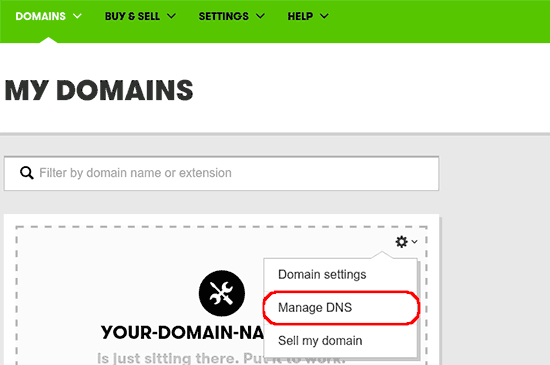
You need to log in to your Godaddy account and click on the Manage button next to Domains. After that, you need to click on the gear icon next to your domain and then select Manage DNS.
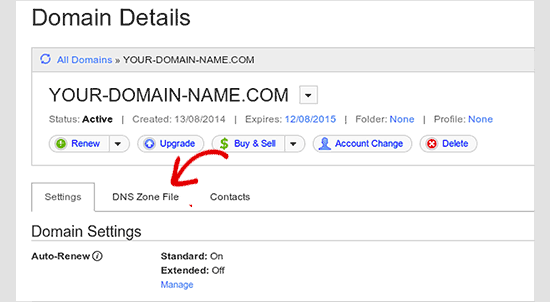
You will see your domain information page. Next, you need to click on DNS Zone File. This is where all the DNS level records of your domain are stored.
On the DNS Zone File page, you need to locate and delete the A records and CNAME aliases you added for your Blogger blog.
Don’t forget to click on the Save Changes button to apply your changes.
The next step is to setup the nameservers for your WordPress hosting provider.
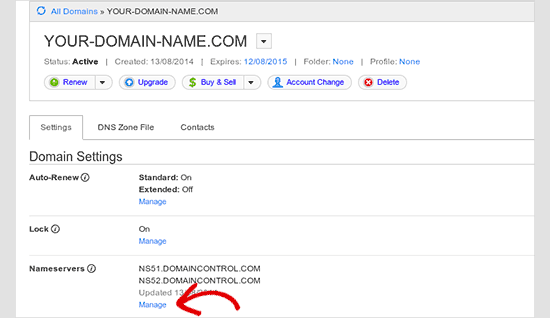
Go back to Manage DNS page for your domain and then click on ‘Manage’ under the Nameservers section.
On the next page, you need to click on ‘Custom’ and then click on the Edit Nameservers link to add your new WordPress host nameservers.
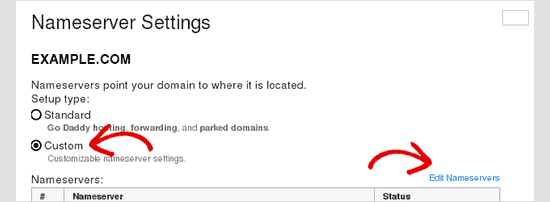
Click on the Save button to make your DNS changes live.
Important: It may take a few hours to a day or two for the DNS changes to be fully implemented. During this time, you can access your Blogger blog by logging into your account.
Step 3: Remove Domain Redirect
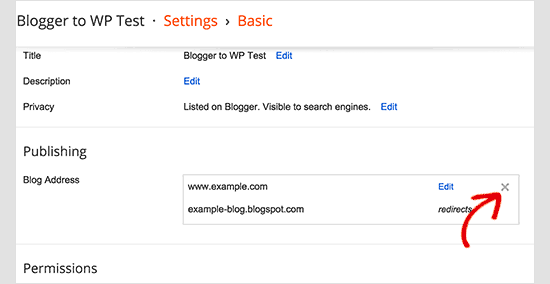
The original blogspot.com address of your Blogger blog is redirecting users to your custom domain. Since we have changed the domain settings, we need to remove it from Blogger as well.
Simply log in to your Blogger account and go to Settings » Original page. Under the Publishing section, click on the cross icon to cancel the redirect.
Step 4: Install WordPress
If your domain’s DNS is now propagated, you can install WordPress on your hosting provider.
If your domain is registered at a third-party service other than your web host, you will need to add hosting for the domain.
For example, at Bluehost you would add your domain as an addon domain through the cPanel unless it is the main domain on your account.
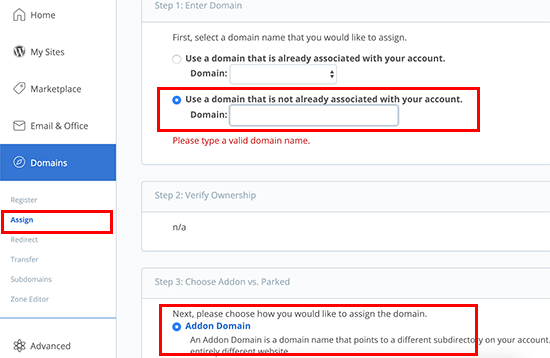
After adding the domain to your new host, the next step is to install WordPress. Most hosting companies have simple 1-click WordPress installers that you can use to quickly install WordPress.
If you need more help, follow the instructions in our complete WordPress installation tutorial.
After a successful installation of WordPress on your custom domain, you will be ready to import content from your Blogger blog.
Step 5: Export Content from Blogger
Before you can import content into WordPress, you must first export it from your Blogger blog.
Blogger allows you to export content in an XML file.
Simply login to your Blogger blog and go to Settings » More page. Under Blog Tools, click on the Backup Content link.
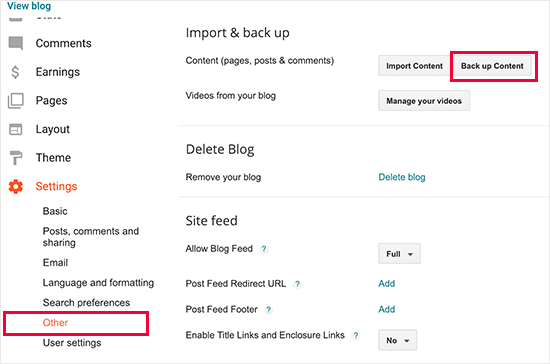
This will bring up a popup where you need to click on the ‘Save to your computer’ button.
Depending on the file size, this may take a few seconds or a few minutes. Once you have your data, it’s time to import it into your WordPress site.
Step 6: Import Blogger Blog to WordPress
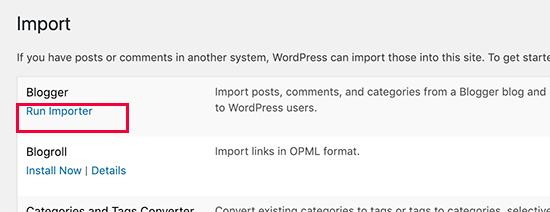
Login to your WordPress admin area and go to Tools » Import page. There you will see a list of importers for different services. You need to click on Blogger to install the Blogger importer.
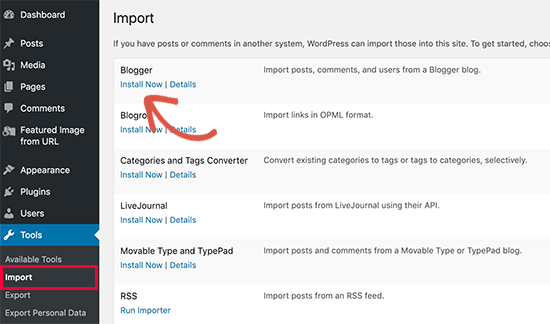
WordPress will now download and install the Blogger Importer plugin for you. Once it has finished installing the plugin, you will need to click on the Run Importer link to continue.
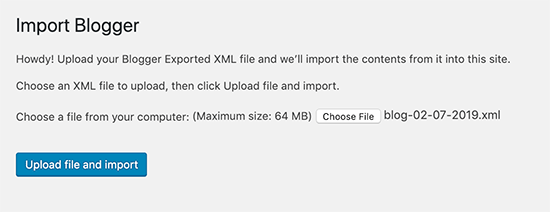
On the Import Blogger screen, WordPress will ask you to upload an XML file. Simply click on the Choose File button and upload the XML file you downloaded earlier. Click on the Upload File and Import button to continue.
WordPress will now import your blog posts from Blogger, once it has finished you will be asked to assign an author to the imported posts. You can assign your Blogger posts to an existing author or create a new one.
Congratulations! You have successfully imported your Blogger blog to WordPress.
However, you still need to make sure that you don’t lose any search rankings by redirecting search engines and visitors to the same content on your new WordPress powered website.
Step 7: Setup Permalinks
WordPress comes with a feature that allows you to set up an SEO-friendly URL structure.
However, since you are importing content from Blogger, you want your permalink structure to be as close to your Blogger URL structure as possible.
To set up permalinks, you need to go to Settings » Permalinks and paste this in the Custom Structure field:
/%year%/%monthnum%/%postname%.html
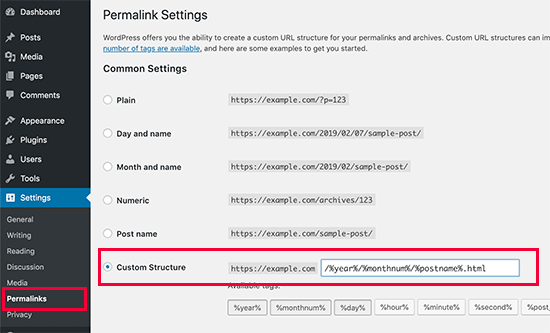
Once this is done, your permalink structure will make the URLs of your WordPress blog posts identical to the URLs of your Blogger blog posts.
However, it is possible that not all of your blog post URLs match the URLs used by Blogger. In that case, you need to paste the following code snippet into the functions.php file of your WordPress theme.
add_action( 'init', 'wpb_update_slug' );

function wpb_update_slug() {
global $wpdb;
$result = $wpdb->get_results("SELECT post_id, meta_value FROM $wpdb->postmeta WHERE meta_key = 'blogger_permalink' ");
$wpdb->print_error();
foreach ($result as $row){
$slug = explode("/",$row->meta_value);
$slug = explode(".",$slug[3]);
$wpdb->query("UPDATE $wpdb->posts SET post_name ='$slug[0]' WHERE ID = '$row->post_id' ");
}
echo "DONE";
}
We would not recommend editing your site’s theme files manually, as even a slight mistake can break your website and prevent you from accessing the WordPress dashboard.
An easy way to add code is to use the Code Snippets plugin for WordPress.
First, install and activate the Code Snippets plugin on your site. If you need help, follow our tutorial on how to add a WordPress plugin.
Once activated, you can go to Snippets » Add New from your WordPress admin area. After that, enter a title for your snippet and then paste the code into the ‘Code’ box.
When you’re done, don’t forget to click the ‘Save Changes’ and ‘Activate’ buttons.
Step 8: Set up feed redirects
You have successfully redirected your Blogger blog to WordPress. However, users who have subscribed to your Blogger RSS feed will stop receiving updates.
You need to redirect feed requests to your WordPress feed. This can be easily achieved by editing the .htaccess file in the root folder of your WordPress site.
If you can’t find your .htaccess file, check out this tutorial.
Start by connecting to your WordPress site using an FTP client. You need to enable the ‘Show Hidden Files’ option in your FTP client settings. If you are using FileZilla, you will find this option under the Server menu.
Once you connect to your website, you will find the .htaccess file in the root directory of your WordPress site. You need to edit this file and paste the following code before any other code in the file.
<IfModule mod_rewrite.c>
   RewriteEngine on
   RewriteRule atom.xml /feed? [L,R=301]
   RewriteRule rss.xml /feed? [L,R=301]
   RewriteRule ^feeds/posts/?.*$ /feed? [L,R=301]
   RewriteRule ^feeds/comments/?.*$ /comments/feed? [L,R=301]
</IfModule>
Don’t forget to save your changes and upload the .htaccess file back to the server. Your Blogger feed subscribers will now be redirected to your WordPress site’s feed.
Step 9. Customizing your WordPress site
Themes control the appearance of your WordPress site. You can use them to change your website’s colors, layout, navigation menus, and more.
By default, WordPress comes with a very simple theme that doesn’t offer many features.
Fortunately, there are thousands of WordPress themes available that you can choose from.
The following are some of our showcases with our expert-picked selection of the best WordPress themes in different categories.
- Best free WordPress blog themes
- Best simple WordPress themes
- Best WordPress themes for writers
Here are some tips you should consider when looking at these themes.
- Simplicity is the best design. Look for a simple theme with flexible features.
- You won’t find exactly the same theme as you found on Blogger, but you can look for a theme with similar layout and color options
- Make sure the theme you’re choosing looks good on mobile devices
- Only install themes from trusted sources like WordPress.org or a top WordPress theme shop.
Once you find a theme, you can go ahead and install it. Check out our beginner’s guide on how to install a WordPress theme for step-by-step instructions.
Note: You can use one of these WordPress page builders to create a completely custom website design without writing any code.
Step 10. Extending your WordPress site
One of the top reasons to use WordPress is the large number of plugins you can use. Plugins are like apps for your WordPress site. You can use them to add new features and extend the functionality of WordPress.
Now, as a beginner, you might be wondering how to start using these plugins? Which plugins should you try first?
Don’t worry we’ve got you covered there too. Check out our expert pick of the essential WordPress plugins you should install first.
Next, you should know that WordPress is not just limited to blogs. You can use it to create any type of website you can imagine.
Add an online store to your blog and start selling.
Create a membership website and start selling memberships and premium content.
Create an online marketplace website to allow others to sell and buy products from your website
Add a job board to your existing website and monetize it.
Finally, as a new WordPress user, you may need help from time to time. MNSCode is the largest WordPress resource site for beginners. We will keep providing you with the best of free resources from time to time.
Discover more from MNS.Code.Blog
Subscribe to get the latest posts sent to your email.

 MNS.Code.Blog